clear
In a future shaped by environmental collapse, privatisation, and failing infrastructure, access to clean drinking water has become increasingly unreliable. Water companies continue to prioritise profit while ageing systems deteriorate beneath growing demand from industry, data centres, and urban expansion.
What happens when clean water becomes a luxury?
DYSTOPIA
The year is 2036.
Clean water still exists, but public access to it has collapsed.
After decades of underinvestment, ageing infrastructure begins to fail at a national scale. Water companies prioritise profitability over public wellbeing as supply is redirected toward AI data centres, industrial agriculture, manufacturing, and the now ultra-profitable premium bottled water industry.
Domestic tap water becomes heavily rationed. What was once an invisible utility becomes scarce, unreliable, and feared.
Hospitals and schools struggle to afford safe water access. Public confidence in government disintegrates as citizens begin to view water not as a basic human right, but as a potential biohazard.
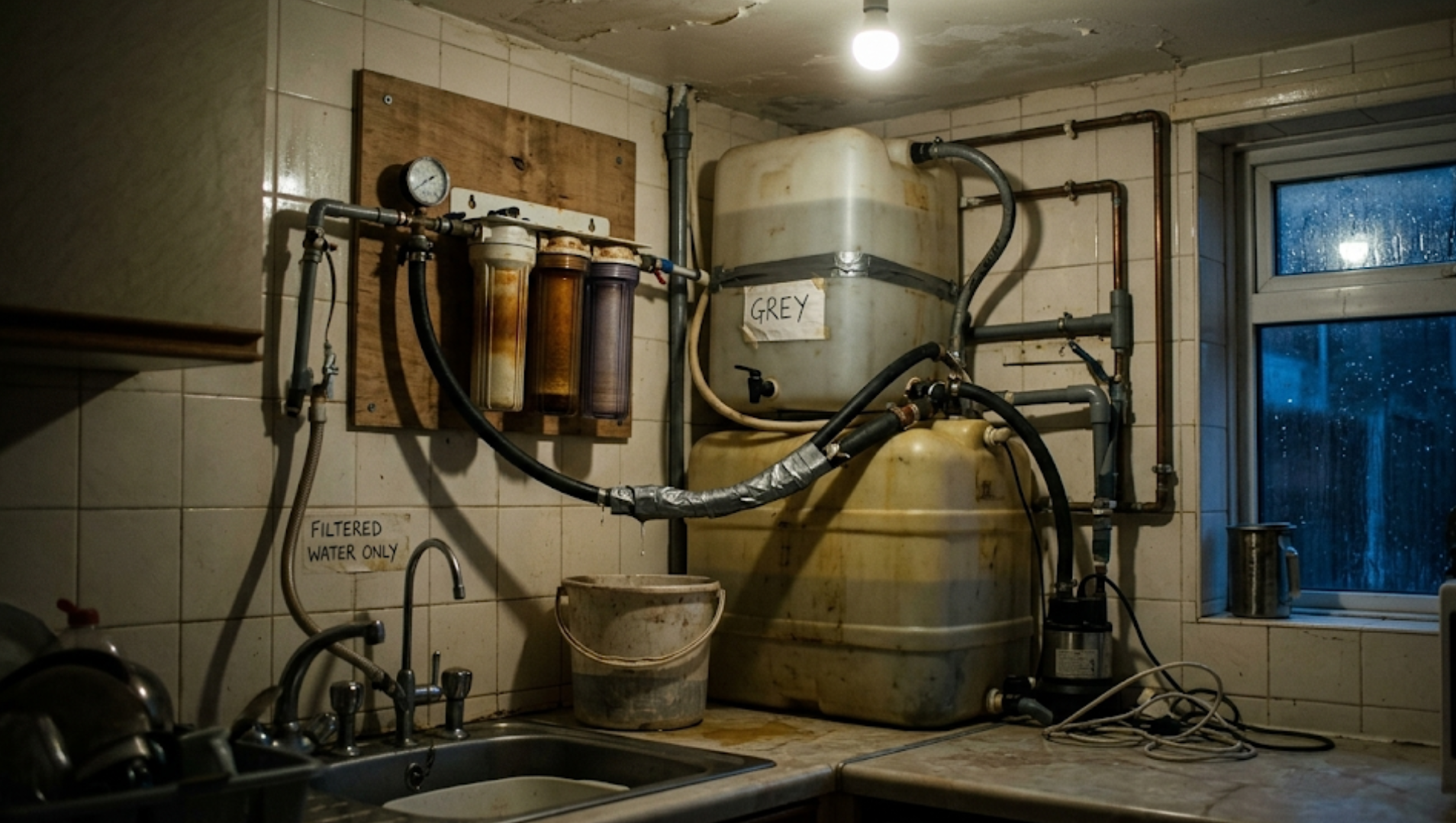
Without trusted infrastructure, households begin constructing makeshift survival systems inside their homes — recycling grey water, rainwater, and even sewage through improvised filtration loops. These systems provide temporary relief but slowly poison residents over time.
As desperation rises, criminal syndicates exploit unregulated freshwater sources. Illegal water markets emerge across cities. Trust collapses entirely.
Water is no longer shared infrastructure. It is survival.
DYSTOPIA
Infrastructure collapse from underinvestment; water industry prioritises profit over people
Supply diverted to AI data centres, industrial agriculture, and premium bottled water
Domestic tap water strictly rationed; public trust in government gone
Homes become DIY grey water/sewage recycling units, slowly poisoning residents
Criminal syndicates exploit natural freshwater; black market water trade skyrockets
UTOPIA
Free, modular, repairable domestic water purifier in every UK home
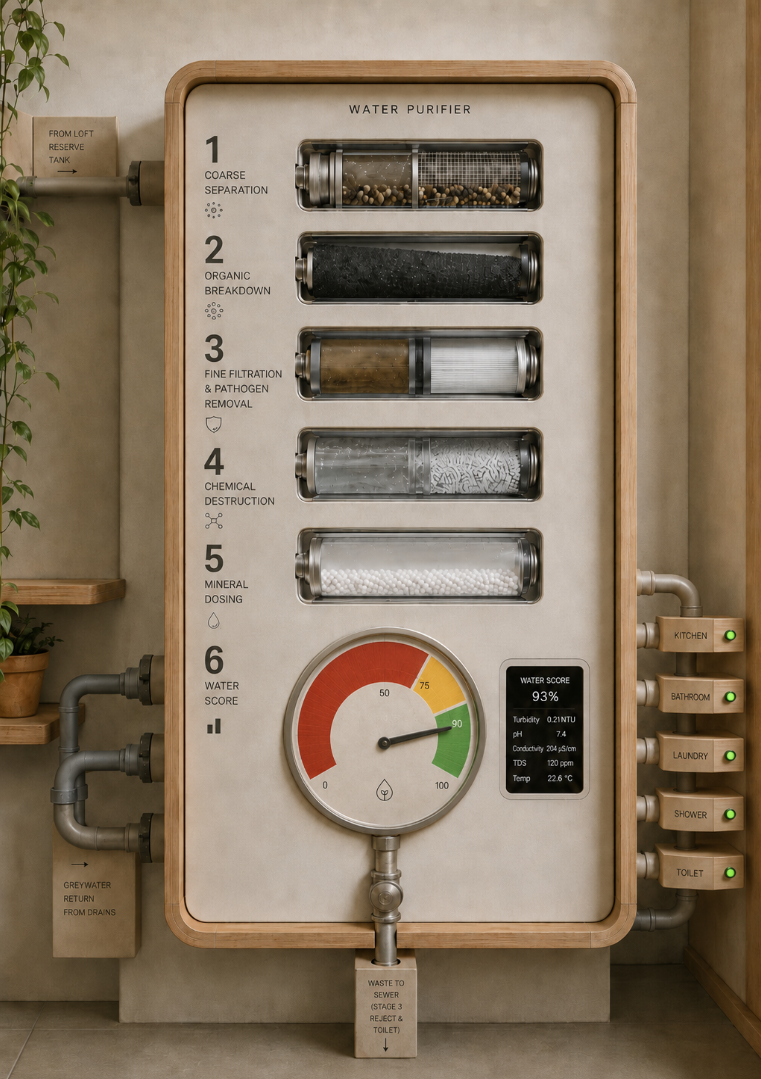
Physical transparency: all filtration stages visible; analogue trust dial (turbidity, pH, TDS, temp) — no software, can't be spoofed
Community maintenance days monthly at town halls; volunteer "water stewards" covering 50–100 households
Independent quarterly verification published outside government control
Rollout via schools first, public billboards, then households; targets all demographics
UTOPIA
To counter the zero-trust landscape, a new decentralised public initiative emerges.
Instead of rebuilding trust through government messaging or invisible infrastructure, the system rebuilds trust through physical transparency, community ownership, and visible verification.
At the centre of the proposal is a free domestic water purification system installed in every UK household.
The machine is modular, repairable, and fully open-source.
Unlike modern “black box” technology, every stage of filtration is physically visible. Citizens can literally watch contaminated water move through each purification stage until it becomes safe to drink.
Rather than relying on software interfaces or hidden algorithms, the purifier uses an analogue trust dial displaying live readings across five visible metrics:
Turbidity
pH
Conductivity
Total dissolved solids
Temperature
The dial itself becomes the trust mechanism.
It cannot be spoofed. If the system fails, it fails visibly.
The technology is supported by a new civic infrastructure:
Monthly community maintenance days hosted in town halls
Volunteer “water stewards” supporting 50–100 households each
Independent quarterly verification published outside government control
Open-source repair and filtration data accessible to all citizens
Trust is rebuilt not through authority, but through participation.
The project proposes a future where communities collectively maintain their own water security — transforming water purification from an invisible service into a visible social responsibility.
In this future, people no longer trust corporations or governments blindly. They trust what they can see, repair, verify, and maintain together.
Meet the Team
-
![]()
Zain Jelassi
Design, Innovation & Creative Engineering